英语
 西班牙语
 简体中文
Industry News
Home / News / Industry News / Granule packaging machine: Applications, Selection Criteria, and Practical Guidance
Content
Granules look easy to pack until you stand next to a machine that has to drop exactly 250 grams of them into a bag, seal it flat, and repeat that two thousand times an hour. Sugar, rice, nuts, coffee beans, plastic pellets, fertiliser prills, screws and tablets all share the word "granule", yet they flow, dust, bounce and settle in completely different ways. We have spent close to two decades building granule packaging machines for food, pharmaceutical, agricultural and hardware producers, and the same lesson keeps coming back: the machine itself is rarely the difficult part. Matching dosing, film, bag style and speed to your actual product is what decides whether a line runs quietly or fights you every shift.
What follows is the conversation we usually have with a new customer, arranged in the order those questions tend to matter.
At its simplest, a granule packaging machine performs four jobs in a continuous rhythm: it forms a bag from roll film, measures a dose of product, releases that dose into the bag, and seals and separates the finished pack. On a vertical form fill seal machine the film travels down over a forming tube, a vertical seam closes the tube into a cylinder, and a horizontal jaw pair seals the top of one bag and the bottom of the next in a single stroke. Everything else, from the dosing head to the date coder, hangs off that basic sequence.
Dosing is where machines differ most, and where most of the budget goes. These five methods cover the overwhelming majority of granule applications.
Accuracy claims deserve a second look. A combination weigher fed a steady, free-flowing product will hold its target weight comfortably; the same machine fed a clumping or damp granule will not, no matter what the brochure says. Always ask for a trial on your own material rather than the supplier's demo sample.
Format follows pack size, pack style and output target. The table below summarises the configurations we build most often for granular products, and roughly where each one sits. Treat the numbers as starting points, not promises, because film structure, product behaviour and target weight all move them.
| Machine format | Usual output | Best suited to | Common bag styles |
|---|---|---|---|
| Compact vertical form fill seal | 30 to 80 bags/min | Small sachets and pouches of sugar, salt, seasoning, seeds, coffee | Back seal, three-side seal, four-side seal |
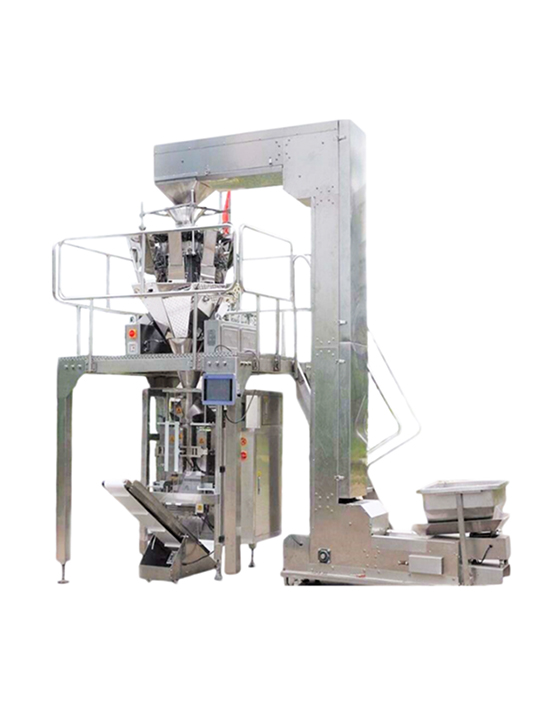
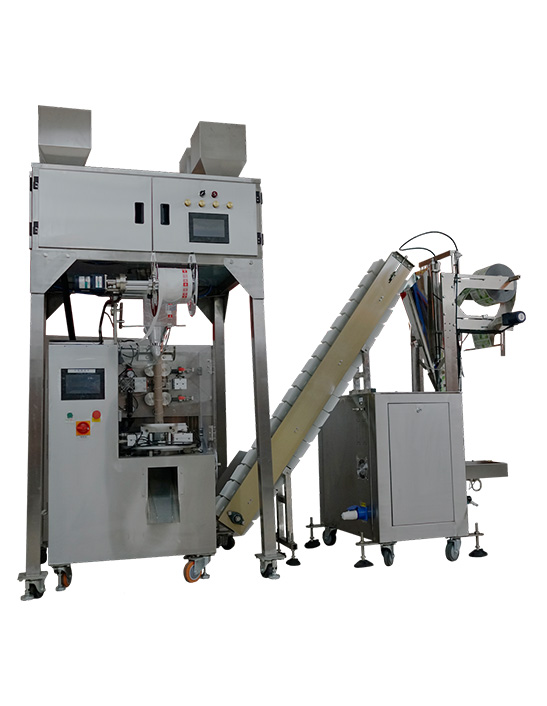
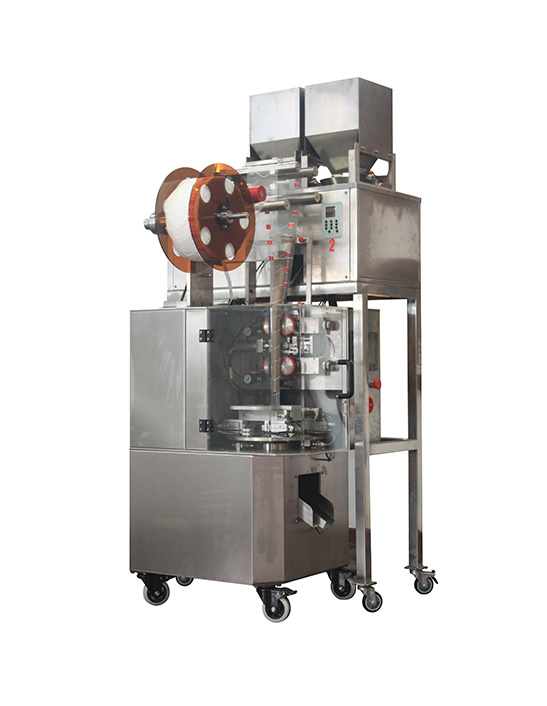
| Large vertical with multi-head weigher | 20 to 60 bags/min | Retail packs from 200 g to 5 kg, snacks, grains, frozen goods | Pillow, gusset, quad seal |
| Premade pouch filler | 20 to 60 pouches/min | Stand-up, flat-bottom, zipper or spouted retail pouches | Doypack, flat bottom, zipper |
| Volumetric cup machine | 40 to 100 bags/min | Consistent-density products on cost-sensitive lines | Three-side seal, back seal |
| Counting machine | 10 to 40 bags/min | Screws, fasteners, tablets, mixed hardware kits | Three-side seal, back seal, round corner |
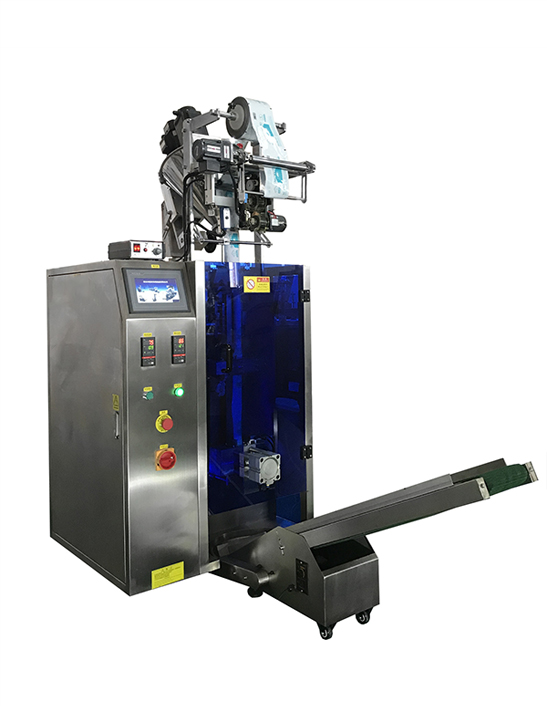
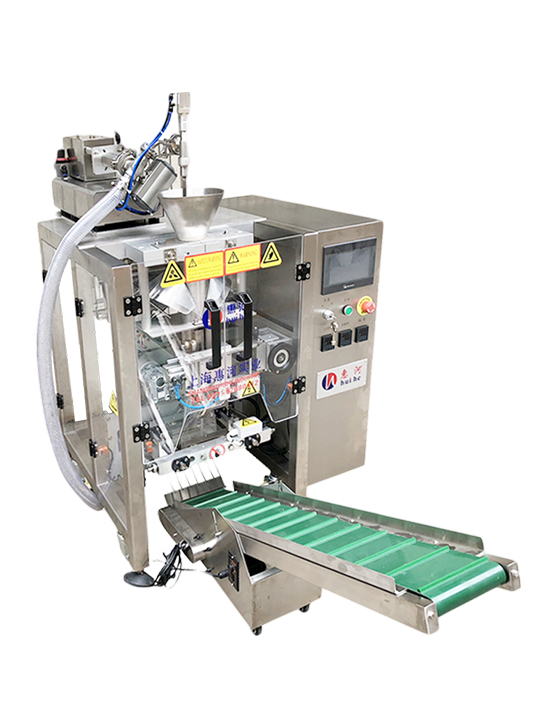
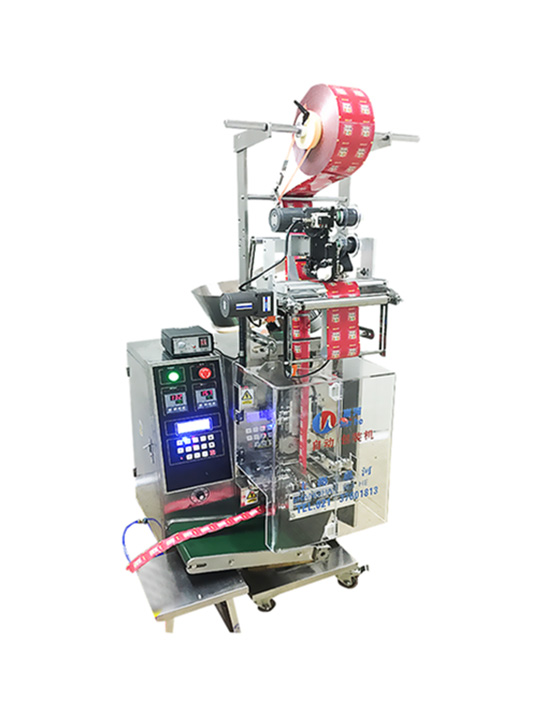
 DXDK-80Z High-Speed Granule Sachet Packing MachineA compact vertical machine for small sachets and pouches, with step-motor metering and 3- or 4-side seal options for granule products.View Product →
For sachets and small pouches, a compact high-speed vertical machine is usually the most economical answer, and it is the format most first-time buyers start with. Above roughly one kilogram per bag, the film path, the jaw pressure and the dosing head all need to grow, which is why large-frame machines paired with a weigher exist as a separate class rather than an upgrade option.
Premade pouches are a different philosophy altogether. Instead of forming the bag from roll film, the machine picks a finished stand-up pouch, opens it, fills it and seals it. You gain the shelf presence of a flat-bottom or zipper bag without sacrificing speed, but the pouch itself costs more than film, so the economics only work when the pack is doing real work on the shelf.
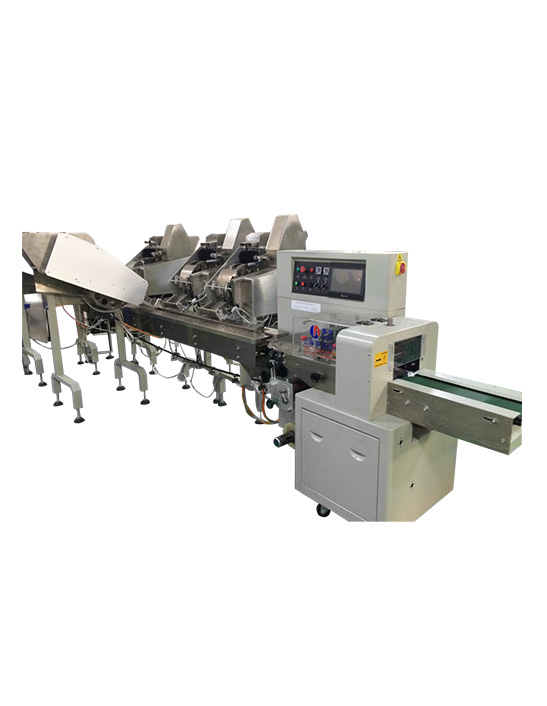
 Automatic Premade Bag Granule Packing SystemA premade-pouch filling and sealing line for granules, combining a multi-head weigher and PLC controls when shelf-ready bags justify the higher pouch cost.View Product →
Six product characteristics decide most of the specification. If you can answer these, a supplier can quote sensibly on the first pass instead of the third.
Our rule of thumb is simple: send a real sample, at production temperature, in a quantity large enough to run for twenty minutes. A machine that behaves on a two-kilogram bag of sample and misbehaves on a tonne of production is a machine that was specified from a catalogue.
Bag style drives both the forming set and the film specification, so it is worth settling early. Back seal is the workhorse for simple pillow packs and gives the widest film economy. Three-side and four-side seal produce the flat, rectangular sachet look familiar from single-serve coffee, sugar and condiments. Round corner bags soften the silhouette and reduce corner damage in transit. Gusseted and quad-seal bags add volume without extra film. Stand-up and flat-bottom pouches give the shelf presence that many retail categories now expect.
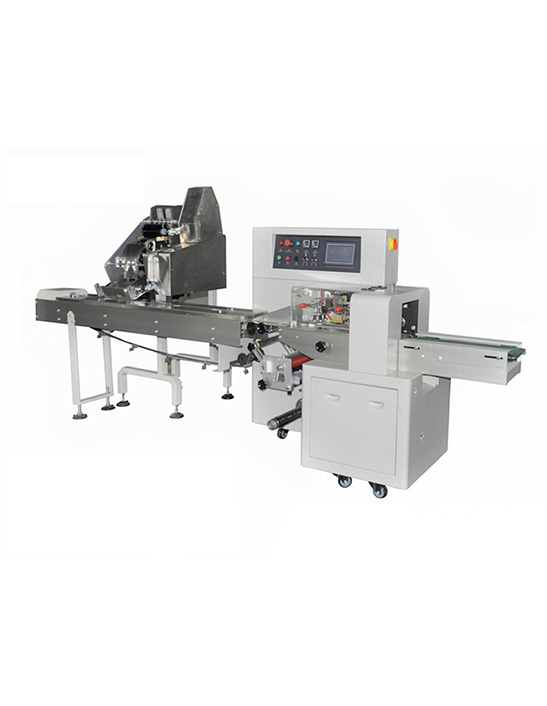
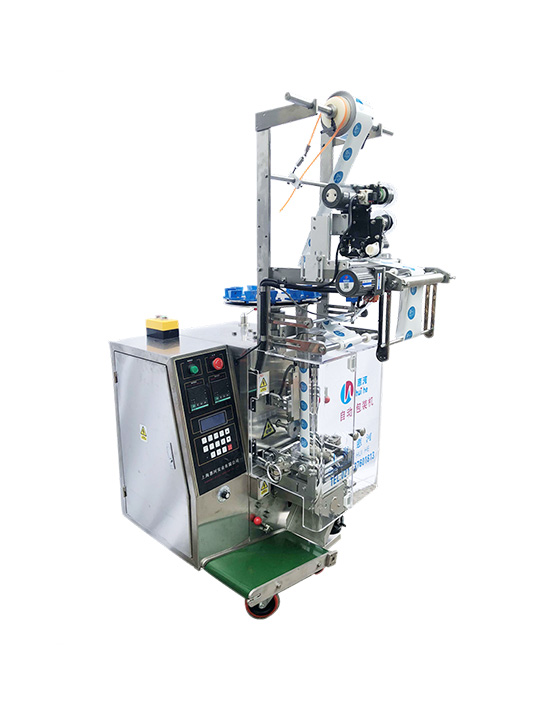
 DXDK-300 Automatic Granule Back-Seal Packing MachineA back-seal granule machine for pillow-style packs, offering step-motor bag pulling and PID temperature control for common laminate films.View Product →
Film choice follows product protection. Heat-sealable laminates such as PET/AL/PE give barrier and stiffness; clear PE or CPP films keep the product visible and cost down. Whatever you choose, the seal must survive the fill, the drop into the carton and the journey, so seal pressure, dwell time and cooling are worth setting properly during commissioning rather than "roughly".
The small features are what make a pack feel finished: tear notches, hang holes, degassing valves for coffee, nitrogen flushing for oxygen-sensitive snacks, and a date coder positioned so the print lands on a flat, readable area. None of these cost much at the specification stage and all of them cost time to retrofit later.
A granule packaging machine rarely stands alone. Bags need counting, collating, cartoning, carton sealing, labelling and eventually palletising, and the bottleneck moves downstream as soon as the filler is fast enough. We usually plan the line backwards from the shipping pallet, then decide how much automation belongs at each stage now and how much can wait until volumes justify it. If you are still weighing the case for automation at all, it is worth reading about the practical benefits of moving from manual scooping to an automated granule packing line before committing to a layout.
We are Soontrue Huihe Automation Equipment (Shanghai) Co., Ltd, a packaging machinery manufacturer founded in 2006, with factories in Shanghai, Guangdong and Hebei and offices in the United States, Thailand, Bangladesh, India and Japan. Our granule machines sit alongside powder, liquid and paste, tablet, tea bag, screw, toothpick and premade pouch equipment, which means a granule project can grow into a full line without changing suppliers halfway. Our equipment runs in food, pharmaceutical, agricultural, chemical, cosmetics and hardware plants, and has been exported to more than eighty countries.
What that spread of experience mostly buys you is fewer surprises. We quote from product samples rather than from a catalogue page, we tell you when a simpler machine will do the job, and we stay involved through installation, operator training and maintenance. Service is the part of the sale that lasts longest, and we treat it that way.
If you are at the early stage of a granule project, the most useful thing you can do today is bag twenty kilograms of your product, note its bulk density and moisture, and write down the pack you want to sell. Send us those three things and we can usually narrow the choice down to one or two machine formats in a single conversation, long before anyone talks about price.
Copyright © Soontrue Huihe Automation Equipment (Shanghai) Co.,LtdAll Rights Reserved. Custom Packaging Machinery Manufacturers