英语
英语 西班牙语
西班牙语 简体中文
简体中文Industry News
Home / News / Industry News / How Do You Choose the Right Horizontal Packing Machine for Your Production Line?
Content
Choosing the wrong packaging machine for your production line is an expensive mistake — one that shows up in downtime, film waste, inconsistent seals, and products that don't survive distribution. Horizontal packing machines are among the most versatile formats in industrial packaging, handling everything from biscuits and cereal bars to pharmaceutical blister packs and hardware components. But "horizontal packing machine" covers a wide range of configurations, and understanding the differences is essential before making a capital investment. This guide explains how these machines work, which variants suit which applications, and what specifications to evaluate during procurement.
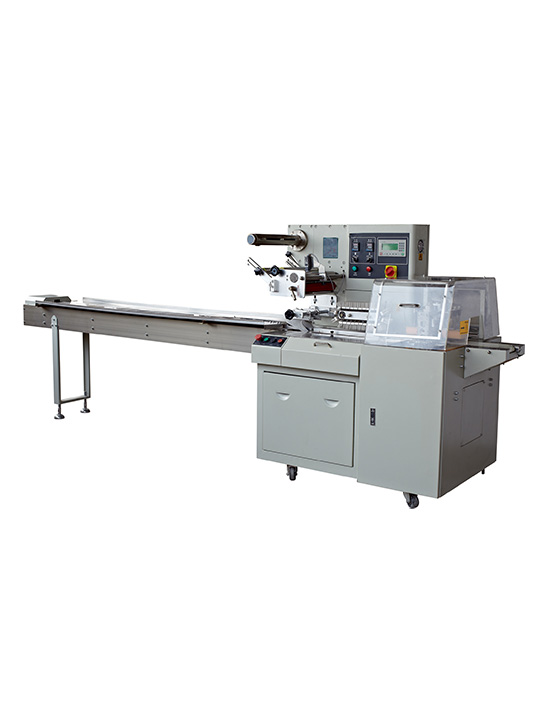
A horizontal packing machine feeds products along a horizontal plane — typically via a conveyor or pusher system — and wraps or seals them using a continuous or intermittent motion mechanism. The fundamental process involves three stages: product infeed, film forming and wrapping, and sealing and cutting.
In the infeed stage, products are placed manually or automatically onto a feed conveyor that spaces them at consistent intervals. The film — usually supplied from a reel mounted below or behind the machine — is formed into a tube around the product using a forming box or collar. The longitudinal (fin or lap) seal runs along the bottom of the package, and transverse seals at the leading and trailing edges complete the enclosure. The sealed package is then cut and discharged onto an outfeed conveyor.
This horizontal orientation is what distinguishes these machines from vertical form-fill-seal (VFFS) equipment, which drops product into a tube from above. The horizontal format is better suited to solid, regular-shaped, or fragile products that would be damaged or difficult to feed vertically — think chocolate bars, soap bars, medical devices, or stacked crackers.
The term "horizontal packing machine" encompasses several distinct machine types. Conflating them leads to misspecification, so it's worth distinguishing the three most common configurations.
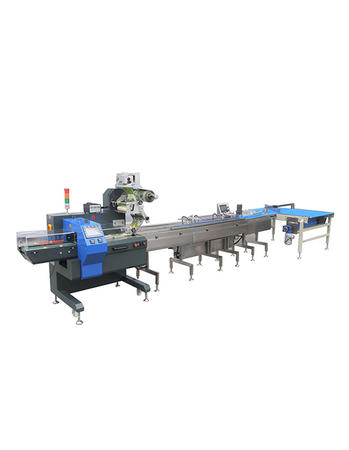
The flow wrapper is the most widely used horizontal packing format. It forms a film tube around the product in motion, creating a pillow-style or fin-seal package. Flow wrappers operate at high speeds — typically 80 to 600 packages per minute depending on product size and machine configuration — and are the standard choice for confectionery, bakery products, fresh produce, and hardware items. The finished package is flexible film (polypropylene, polyethylene, or laminates) with three sealed edges.
Overwrappers wrap pre-formed products or trays in a tight film layer — commonly used for cigarette packs, DVD cases, pharmaceutical boxes, and tissue bundles. Rather than forming a loose pillow around the product, an overwrapper folds film tightly against the product's contours, creating a more rigid, form-fitting package. This format is preferred where tamper evidence, moisture barrier, or presentation quality are priorities.
A horizontal cartoner loads products into pre-formed cartons from the side rather than from above. Cartons are erected from flat blanks, filled horizontally, and then closed — either by tuck-in flaps or glue. This format is common in pharmaceutical, cosmetic, and food packaging where a rigid secondary package is required. Horizontal cartoners are slower than flow wrappers but produce a package with considerably more structural integrity and surface area for labeling.
Horizontal packing machines are specified across a broad range of industries, but they are particularly well matched to applications where product shape, fragility, or presentation requirements make vertical or rotary packaging impractical.
| Industry | Typical Products | Recommended Format |
|---|---|---|
| Food & Confectionery | Chocolate bars, biscuits, cereal bars, sandwiches | Flow wrapper |
| Bakery | Bread loaves, rolls, croissants, cakes | Flow wrapper |
| Pharmaceutical | Blister packs, cartons, sachets | Horizontal cartoner / overwrapper |
| Personal Care | Soap bars, toothbrushes, cosmetic boxes | Flow wrapper / overwrapper |
| Hardware & Industrial | Fasteners, tools, electrical components | Flow wrapper |
| Tissue & Nonwovens | Pocket tissues, wipes, masks | Overwrapper / flow wrapper |
Products that are irregularly shaped, very soft, or prone to crumbling — such as fresh pastries or loosely packed items — often require modified infeed systems (bucket conveyors, tray loading) to maintain product integrity through the wrapping process. Discussing product characteristics in detail with machine suppliers before specification is essential, particularly for non-standard applications.
When comparing horizontal packing machines from different manufacturers, several technical parameters determine whether a machine is genuinely suited to your production requirements — or will become a bottleneck.
Machine speed is typically quoted in packages per minute (ppm). Entry-level flow wrappers operate at 80–150 ppm; mid-range machines run 200–350 ppm; high-speed servo-driven lines can exceed 600 ppm for small, lightweight products. Be cautious of headline speed figures — rated speed is often measured under ideal conditions with a single product size and optimal film. Request speed data for your specific product dimensions and weight, and ask about realistic sustained throughput over an eight-hour shift including changeover time.
Horizontal packing machines have defined minimum and maximum product dimensions for length, width, and height. Confirm your full product range — including future SKUs — falls within the machine's envelope. Changeover time between product sizes is a significant operational cost: manual changeover on older machines can take 60–90 minutes; modern servo-driven machines with recipe storage and motorized adjustments can achieve changeover in under 15 minutes. For production environments with frequent SKU changes, this difference directly impacts line efficiency.
The sealing system determines package integrity and film compatibility. Rotary jaw systems provide consistent seal pressure at high speeds and are standard on most flow wrappers. Box motion jaw systems — where the sealing jaws move in a rectangular path matching product pitch — are preferred for products that are soft or heat-sensitive, as they allow more dwell time at lower temperatures. Ultrasonic sealing is an option for very thin films or cold-seal applications where heat would damage the product or film substrate.
Not all horizontal packing machines handle all film types equally. Confirm compatibility with your required film — whether that is oriented polypropylene (OPP), cast polypropylene (CPP), polyethylene (PE), paper-based laminates, or compostable films. Machines designed for conventional heat-seal films often require hardware and temperature profile adjustments to run cold-seal or paper-based materials reliably. If sustainability requirements mean transitioning to recyclable mono-material films in the next 1–3 years, this should be part of the machine specification discussion now.
This is one of the most practically important choices in horizontal packing machine selection, and it's frequently under-explained in product specifications.
Intermittent motion machines stop the film momentarily during the sealing and cutting cycle. This makes them mechanically simpler, easier to maintain, and better suited to fragile or irregular products that need precise positioning at the seal point. They are the standard choice for smaller production runs, pilot lines, and applications where product spacing is inconsistent. Speed is limited — typically under 150 ppm — by the stop-start cycle.
Continuous motion machines move film and product simultaneously throughout the entire cycle, with sealing jaws that track product movement. This allows significantly higher throughput but requires more consistent product infeed spacing and a more sophisticated control system. Servo-driven continuous motion machines — now the industry standard for mid-to-high volume production — offer precise jaw timing, reduced mechanical wear, and the ability to store multiple product recipes in the HMI for rapid changeover.
For operations running a single product at high volume, continuous motion is almost always the right choice. For flexible operations with multiple product types, small batches, or artisan production, intermittent motion provides the reliability and simplicity that keeps overall equipment effectiveness (OEE) high without complex maintenance demands.
A horizontal packing machine rarely operates in isolation. Understanding how it integrates with upstream and downstream equipment is critical to avoiding bottlenecks that undermine the machine's rated capacity.
Before finalizing any horizontal packing machine purchase, request a line layout drawing from the supplier that shows all equipment positions, conveyor runs, and operator access zones. This drawing, reviewed against your facility's floor plan and production flow, will reveal integration issues far more reliably than any specification sheet.
Use this checklist when evaluating machines and suppliers to ensure the investment delivers the expected return:
A horizontal packing machine is typically a five-to-fifteen-year capital asset. The supplier relationship — spare parts availability, service responsiveness, and software support — matters as much as the machine specification itself. Investing time in supplier qualification before signing a purchase order is consistently the most cost-effective step in the procurement process.
Copyright © Soontrue Huihe Automation Equipment (Shanghai) Co.,LtdAll Rights Reserved. Custom Packaging Machinery Manufacturers