英语
英语 西班牙语
西班牙语 简体中文
简体中文Industry News
Home / News / Industry News / How Do You Choose the Right Toothpick Packing Machine for High-Speed, High-Volume Production?
Content
Toothpick packing machines are a critical piece of equipment for manufacturers looking to automate the final stage of toothpick production — the step where loose toothpicks are counted, oriented, grouped, and sealed into retail-ready packaging. Whether you are operating a small regional facility or a high-capacity export production line, selecting the right packing machine determines your output speed, packaging consistency, labor cost, and ultimately your product's competitive position in the market. This guide breaks down how toothpick packing machines work, the main configurations available, and the specifications that matter most when making a purchase decision.
At its core, a toothpick packing machine performs a sequence of mechanical operations that transform a bulk supply of loose toothpicks into neatly packaged units ready for retail or food service distribution. Understanding each stage of this process helps clarify what specifications to prioritize when evaluating equipment.
The process begins with feeding. Toothpicks are loaded into a hopper — either manually or via an automated conveyor system — and transferred to an orientation and counting mechanism. This is one of the most technically demanding stages, because toothpicks are small, lightweight, and prone to bridging or jamming in bulk feed systems. High-quality machines use vibrating bowl feeders or inclined belt conveyors with alignment channels that orient toothpicks longitudinally before passing them to the counting unit.
The counting unit measures each batch by number (using optical sensors or mechanical slots) or by weight (using a multi-head weigher). The counted batch is then transferred to the wrapping or sealing station, where packaging material — paper, polypropylene film, or pre-formed boxes — is applied and sealed around the toothpick bundle. Finished packages are then discharged onto an output conveyor for carton loading or manual collection.
Toothpick packing machines are not a single product category — they differ significantly in packaging format, automation level, and production capacity. Matching the machine type to your packaging requirements is the first decision to make before comparing individual models.
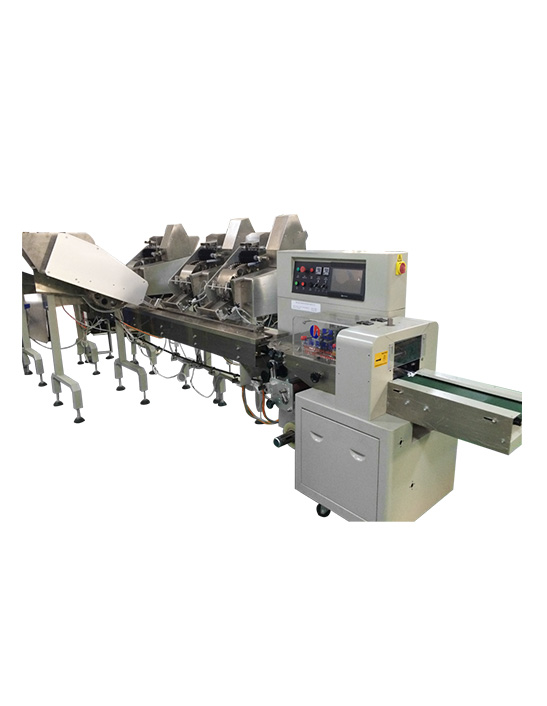
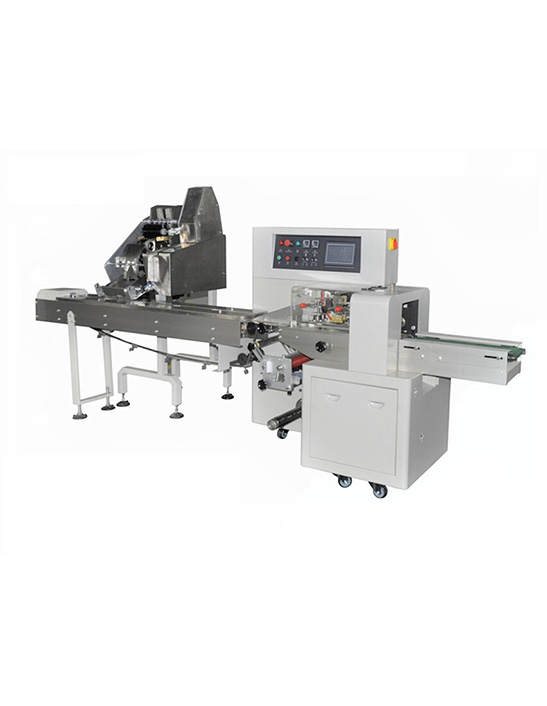
Flow wrap machines are among the most widely used for toothpick packaging in the food service and hospitality sectors. They enclose individual toothpick bundles or single toothpicks in a continuous polypropylene film that is formed, sealed longitudinally, and cut transversely to create a pillow-style pouch. These machines run at high speed — typically 200 to 600 packages per minute — and handle a wide range of bundle sizes. The finished packages are light, compact, and well-suited for restaurant and airline individual-serving formats.
Paper envelope packing machines are designed specifically for inserting toothpick bundles into pre-printed paper sleeves or folded paper envelopes — a traditional format preferred in the Chinese domestic market and across many Asian export markets. The machine folds a strip of paper around a counted bundle of toothpicks and glues or heat-seals the overlap. Output speeds range from 80 to 300 packages per minute depending on machine grade, and the paper format lends itself to high-quality printed branding at relatively low packaging material cost.
For retail toothpick products sold in cardboard sliding boxes or matchbox-style containers, dedicated box filling machines are used. These machines count a precise number of toothpicks — commonly 50, 100, 200, or 500 per box — and insert the batch into pre-erected box shells before closing the outer sleeve. Box-format packaging machines run at lower speeds than film wrappers (typically 30 to 120 boxes per minute), but produce a retail-ready product that requires no secondary packaging before shelf placement.
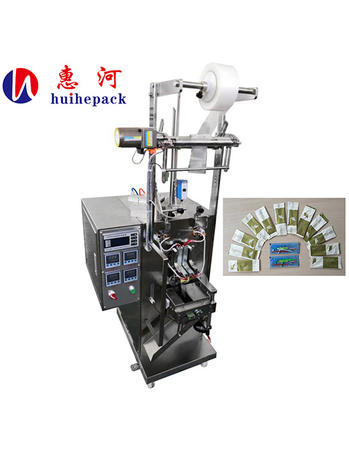
Larger production facilities often run integrated combination lines that combine a primary packing machine (individual bundle wrapping) with secondary packaging equipment (outer carton filling, shrink wrapping, and palletizing). These fully automated lines minimize manual handling between packaging stages and can achieve throughputs exceeding 1,000 retail units per minute when all stations are synchronized correctly.
When evaluating toothpick packing machines from different manufacturers, the following specifications are the most meaningful indicators of performance, reliability, and total cost of ownership. Use the comparison table below as a structured reference:
| Specification | Typical Range | What It Affects |
| Packing Speed | 80–600 packs/min | Daily output capacity and labor cost per unit |
| Counting Method | Optical sensor / mechanical / weighing | Count accuracy and product consistency |
| Packaging Material | PP film, paper, cardboard box | Package format, material cost, branding options |
| Hopper Capacity | 5–50 kg | Frequency of manual refilling and downtime |
| Power Consumption | 1.5–5.5 kW | Operating energy cost per shift |
| Machine Dimensions | Varies significantly by type | Floor space requirements and installation feasibility |
| Control System | PLC with HMI touchscreen | Ease of parameter adjustment and fault diagnosis |
| Toothpick Length Compatibility | 50–100 mm (adjustable) | Flexibility for different product lines |
Packing speed is often the specification buyers focus on first, but it should always be evaluated in context with counting accuracy. A machine rated at 400 packs per minute that delivers inconsistent counts — sometimes 48 toothpicks in a bundle labeled for 50 — creates product quality and regulatory problems that far outweigh the productivity gain. Ask manufacturers for documented counting accuracy data, typically expressed as a percentage defect rate over a defined production run.
The feeding and orientation system is the component most frequently responsible for machine downtime in toothpick packing operations. Toothpicks are dimensionally uniform but their low weight, smooth surface, and tendency to interlock make bulk feeding mechanically challenging. Evaluating the feeding system design carefully before purchase can prevent costly production disruptions.
Vibrating bowl feeders use an electromagnetically driven bowl that vibrates at controlled frequency and amplitude to sort and orient toothpicks along a spiral track. They are reliable and widely used, but require regular adjustment as toothpick dimensions or surface conditions (moisture content, wood type) vary. Bowls must be appropriately sized for the production rate — undersized bowls become the throughput bottleneck, while oversized bowls waste floor space and energy.
Some machines use a step elevator — a vertically reciprocating platform with comb-like fingers — to lift toothpicks from a floor-level hopper to the machine's working height while naturally aligning them longitudinally. Belt conveyor feeding systems are an alternative that offer gentler product handling and easier access for cleaning. Both systems are less prone to jamming than bowl feeders when handling large volumes of toothpicks continuously.
The sealing station determines the integrity and appearance of the finished package. Different sealing technologies are appropriate for different packaging materials, and the choice affects both machine cost and ongoing packaging material cost.
Toothpick packing machines are available across a broad spectrum of automation levels, from semi-automatic machines requiring an operator to load packaging material and remove finished packages manually, to fully automatic systems integrated with upstream toothpick production equipment and downstream carton erecting, filling, and palletizing lines.
For facilities producing fewer than 500,000 packs per day, a semi-automatic or standalone automatic machine with manual carton loading is typically the most cost-effective choice. Labor costs remain manageable at this scale, and the lower capital expenditure of a standalone machine allows faster return on investment. For large-scale operations targeting daily outputs above 1 million retail packs, the economics shift in favor of a fully integrated line where each stage feeds the next automatically, minimizing labor costs and reducing the quality variability introduced by manual handling between stations.
When specifying integration requirements, confirm that the packing machine's discharge conveyor speed, package dimensions, and output buffer capacity are compatible with the input specifications of any downstream equipment. Mismatched line speeds between stations cause accumulation or starvation that degrades overall line efficiency significantly.
Beyond the technical specifications, several practical factors determine whether a machine delivers satisfactory performance and long-term value in your specific production environment. The following checklist covers the most important pre-purchase verification points:
A toothpick packing machine represents a significant capital investment, and calculating the expected return on investment (ROI) before purchase provides an objective basis for comparing machine options at different price points. The primary financial drivers to quantify are labor cost savings from automation, the reduction in packaging waste from improved counting accuracy and seal consistency, and the revenue impact of increased production capacity.
For example, if a manual packing operation requires six workers per shift to produce 20,000 packs per eight-hour shift at a labor cost of $15 per hour per worker, the labor cost per pack is approximately $0.036. An automated machine producing the same volume with one operator reduces the labor cost per pack to approximately $0.006 — a saving of $0.03 per pack. At an annual production volume of 50 million packs, this labor saving alone amounts to $1.5 million per year, which justifies a machine investment in the $80,000 to $200,000 range with a payback period well under two years.
Actual ROI calculations should also factor in machine uptime (typically 85–95% for well-maintained equipment), electricity costs, packaging material consumption rates, and any additional revenue generated by the capacity expansion. Request production data from reference customers of the manufacturer — operations running similar products at comparable scale — to validate the uptime and throughput figures before committing to a purchase decision.
Copyright © Soontrue Huihe Automation Equipment (Shanghai) Co.,LtdAll Rights Reserved. Custom Packaging Machinery Manufacturers